CHEF PROFILE
Forest to Table
The forager and sorcerer of local bounty, Chef Salvatore Friedel’s favorites arrive as often as seasonally available in Waupaca.
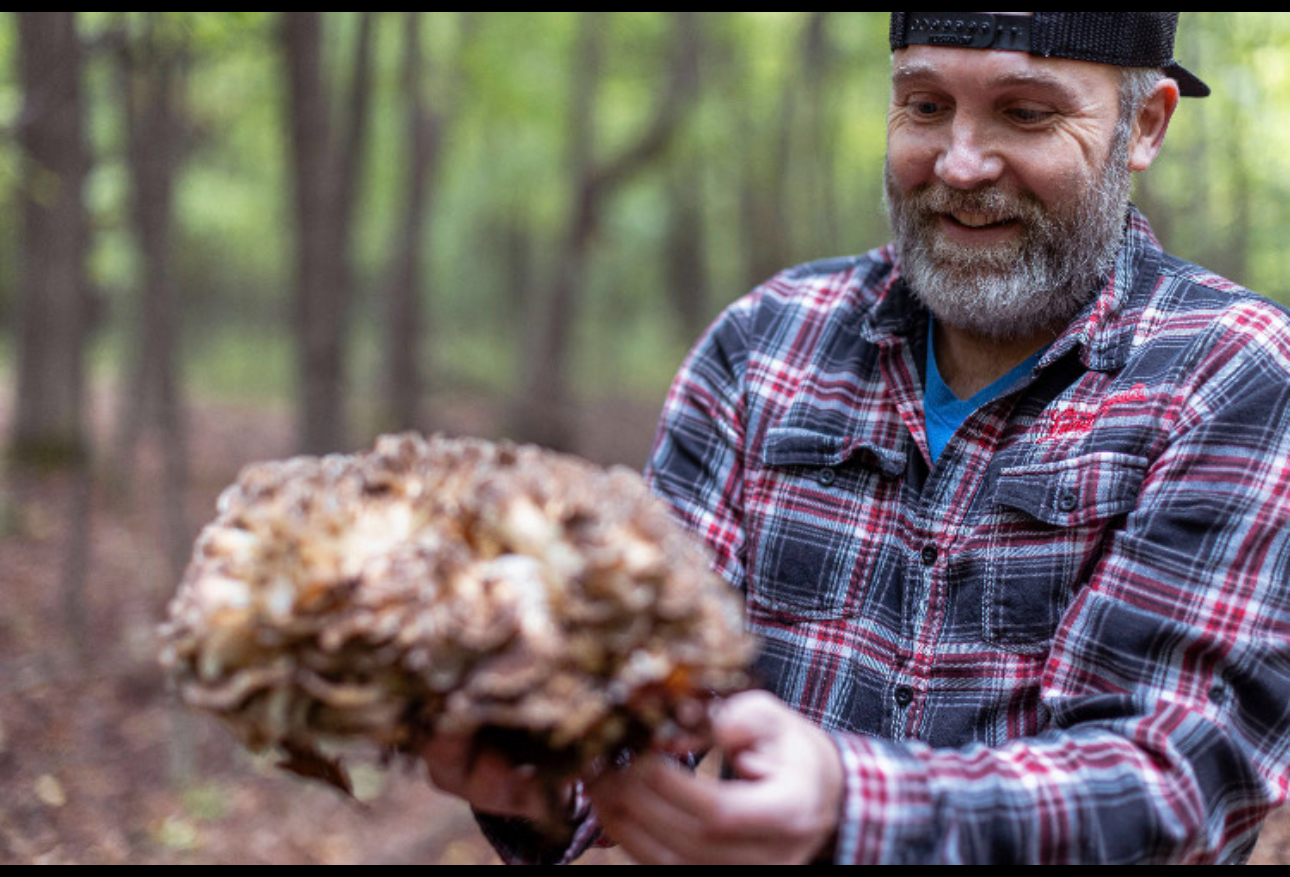
WHEN SALVATORE FRIEDEL IS NOT CREATING DISHES at the Green Fountain Inn or snuggling with his two English bulldogs, he is often in the forest foraging for mushrooms and other wild edibles: chicken of the woods, black raspberries or the coveted morel. He first became intrigued by the foraging process in 2012 when he came upon a carpet of chanterelle mushrooms on his mom’s land in Waupaca, the picturesque chain-of-lakes getaway so many Wisconsinites favor. Foragers have a unique connection with the woods, the earth and the gifts they offer. Poet Sylvia Plath echoes this respect by personifying mushrooms who “whitely, discreetly … shoulder through holes” and “diet on water and crumbs of shadow.” The mushrooms in Plath’s poem eventually become “shelves” or “tables” who “inherit the earth.” Plath’s description reminds us of nature’s rhythm and how it cannot be forced. This is one reason that it requires patience to forage. Sometimes a forager can find an entire blanket of black trumpets waiting for them; other times, kneeling to look through the silhouettes of grass, logs and leaves yields only half a pound of mushrooms. Sal shared, “That’s because Mother Nature is the boss. She does things on her own terms.”
True foragers aren’t deterred. They know they can perhaps just wait and return to find a mushroom “shelf” waiting. In fact, Sal has had experiences where he has waited only a short time; he has walked away to explore another area and returned to his original spot to find mushrooms, as if they had been playing hide-and-seek. Sal shares, “I believe that mushrooms are almost sentient beings. I will walk through the forest, check very small areas many times, then walk through five minutes later and see some bright orange mushrooms staring at me. I feel like they do that on purpose.” Even if their basket remains empty, the trip is not wasted. The forager has spent time among the trees, and a chef has spent time in the shade of green, rather than in the heat of the stove.
Weather, of course, affects growth and time of harvest. This past spring, rain and humidity gripped Wisconsin. “While precipitation usually advances mushroom growth, all of the rainy nights we had were followed by very cool days. We needed mornings that were a bit warmer to get the mycelium brewing. When we finally got warmer weather, it was way too hot. And when more rain came, it was too late. There was a short burst of morels, but that was it.” Stagnant, overly damp weather combined with high heat can lead to competing molds and bacteria attacking the mycelium, which is the roots or fibers of the mushroom. Regardless of the weather, true foragers like Sal are out in the Wisconsin woods from May to November, seeking treasure. Where? Well, they don’t always reveal their “spots.” In fact, Sal was gathering Ghost Chanterelles the morning of our conversation but specifically where is a detail he will keep tucked away. “Oh. I will not be revealing THAT. I will just tell you that I drove three hours.” Who knew foragers could be rather mysterious? I think some fishermen are like this too. Not only are they secretive stewards of bringing forth Mother Nature’s gifts, some can be quite strategic. One of Sal’s acquaintances looks at logging maps to determine where he will find a bounty, as mushrooms become “nudgers and shovers,” as Plath describes, and maneuver above the earth when a damp log is near.
This sought-after treasure cannot be sold or traded without certification through the state of Wisconsin and the Wisconsin Mycological Society. Foragers who wish to sell their mushrooms must take a day-long course to ensure they know proper identification, safety and quality. Interestingly, Wisconsin is home to more than 2,000 mushroom species, and roughly 200 are edible, but the state only endorses certain mushrooms for the restaurant table. Restaurants and vendors are allowed to sell only eighteen categories of mushrooms. Sal is certified through these outlets and prepares and serves almost all of these approved species. Sal’s passion lies in respect for local food. Handpicked Wisconsin mushrooms are featured on his menu year-round, as he preserves them in various ways. “When I write a menu, I start with the mushrooms that I’m currently picking because I think those are the closest emotional connection to me; they are the things that I am touching, I’m the one who’s harvesting them. I’m the one cleaning them, I’m cooking them and I’m talking about them. Still, I’m at the mercy of Mother Earth as she is the farmer,” shared Sal. He also processes many other local and seasonal ingredi- ents at their peak of freshness by rendering pork tallow, freezing local berries, creating broth from mushrooms and crafting butter from wild leeks and garlic. However, most of his plates at the historic inn feature fresh, seasonal local farm fare. The dining area at the inn, with its old wood floors, vintage desk and large curtained windows, seats only 20 patrons. Sal has the luxury of creating his menu each Tuesday evening for the week. He can text his local farmers on the weekend and see what they have and what he will be getting. “I don’t ask farmers to grow specific things for me. That just seems like it would be really selfish. How do I plan the menu? I know what I will most likely be getting based on the season, and I just send them a text to clarify what will be delivered. Then, I plan the menu based on that text. I couldn’t do that if I worked in a bigger place. It’s an advantage that I have here.”
Sal describes the local farmers as friends. His descriptions of their farms showed his respect for them and the work they do each day. Green Fountain Inn buys various items from Purslane Farm, a small family-run farm in Waupaca that specializes in unique varieties of vegetables, various herbs and even edible flowers. Gravel Road Farm also provides vegetables and herbs. Drath Family Farm in nearby Ogdensburg provides the inn’s Wagyu beef. Produce Point provides fresh lettuce grown hydroponically; in fact, the lettuce is delivered with the roots still intact and Sal leaves the roots on until directly before he makes a salad. Other local farmers provide pork, chicken and duck eggs. Sal’s most endearing salesperson currently? An eight-year-old girl who sells him eggs. Genevieve decided to take on the task of raising chickens, gathering their eggs and giving her “egg money” to the nearby food pantry. Sal values simplicity as a chef. He believes his biggest strength lies in his respect for ingredients. When using fresh ingredients, simplicity is entirely possible. Sal wants to feature the main ingredient, the product the farmer has brought him: “Isolate the seasonal ingredient. Respect the carrot for being a carrot. Embrace simplicity.” He continues, “When I make peach ice cream, sure, I might put some Pernod or some Mascarpone or some other things in. That’s really fun, but I want you to really taste the peach and think ‘wow.’ I want to make you happy. It’s about joy. And I think that so many chefs make it too intellectual.”
When building a menu, Sal’s respect and consideration extend beyond the woods and beyond the farmer and his produce to the farm animal. “As consumers, we need to be open to ingredients that are out of our comfort zone. A start is being open to trying new cuts of meat. We need to think about and attempt to try different cuts of meat. We all like tenderloin, but that’s a small part of the cow considering we raised and killed that animal only to eat it. The respectful thing is to use it all.” Sal plays with his menu by offering “beef cheeks” sometimes and creating broths with boiled pig heads for his well-known ramen nights at the inn. Chef Sal Freidel values the offerings of the forest floor, his local farmers and the lives of animals, all to bring us “joy” on a plate. He believes he presents simplicity among his food, but his deference for what nature provides is not simple — it’s multi-layered. Sylvia Plath’s personification of mushrooms declaring that in their growth they “inherit the earth” is one that humans could apply to themselves as well, as we also have “inherited” the earth in a sense. Respect for forest and farm serves as an expression of gratitude for what we have inherited.